Blog Post
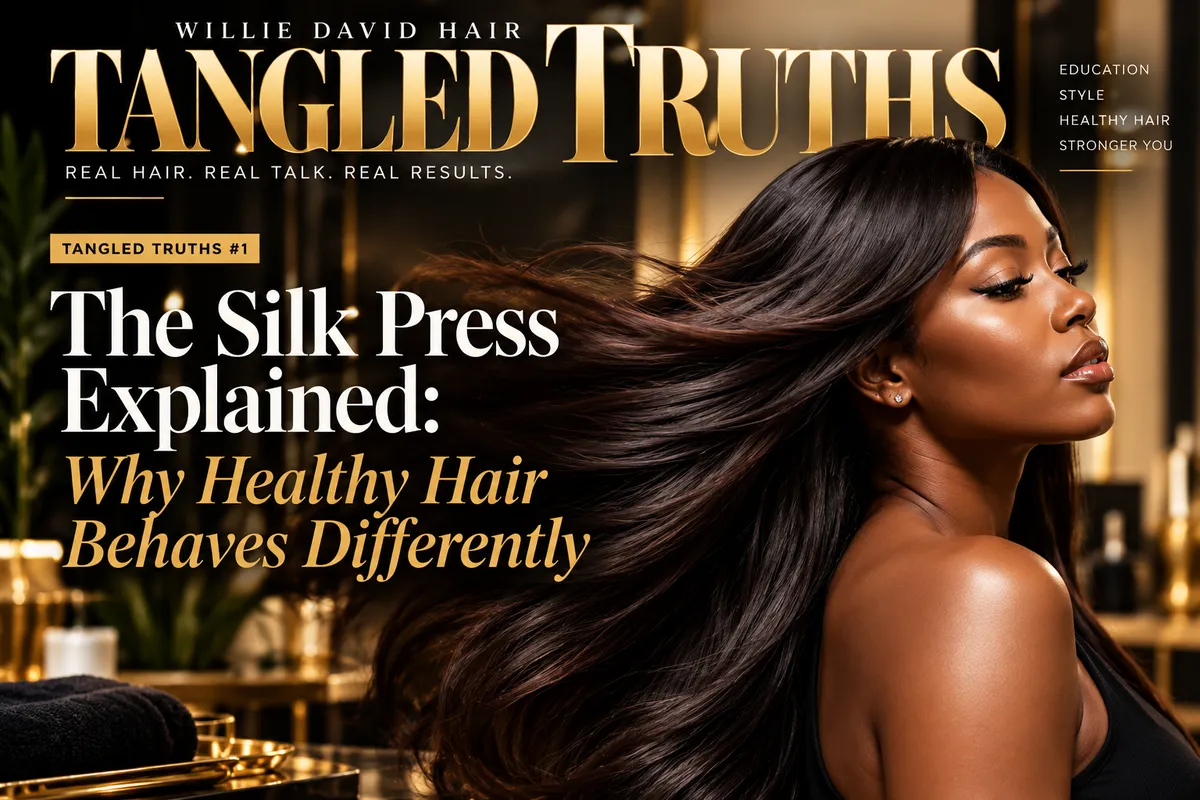
The Silk Press Explained: Why Healthy Hair Behaves Differently Under Heat
For years, the silk press has been catching charges for crimes it didn't necessarily commit.
Heat damage. Breakage. Dryness. Reversion.
And listen, some of that fear didn't come out of nowhere. Plenty of people have had bad experiences with heat. But the problem isn't simply that somebody picked up a flat iron.
The condition of the hair matters.
The preparation matters.
The temperature matters.
The technique matters.
And how often you're doing it matters.
So here's the Tangled Truth:
Heat does not automatically equal damaged hair. But healthy-looking results require more than turning on a flat iron and hoping for the best.
A silk press isn't just about making textured hair straight.
It's about understanding how the hair in front of you responds.
And baby, hair will tell on everything.
A Silk Press Is More Than Straight Hair
A good silk press should give you movement, shine, body and a smooth finish without requiring somebody to wrestle your hair into submission.
That's where people sometimes misunderstand the service.
The goal isn't:
“How straight can we get it?”
The better question is:
“What does this hair need to give us the result we want while still respecting the hair?”
Because two people can sit in my chair on the same day, receive the same type of service and walk out with completely different results.
Why?
Because I'm not working on the same head of hair twice.
Texture can be different.
Porosity can be different.
Density can be different.
Previous chemical services can be different.
Color history can be different.
Home care can be different.
The current condition of the hair can be different.
That's why professional hair care can't be reduced to one temperature, one product or one technique for everybody.
Hair is personal. The service should be too.
Preparation Determines Performance
One of the biggest Tangled Truths about a silk press is this:
No silk press should begin with a flat iron.
It begins at the shampoo bowl.
Before I worry about making the hair straight, I'm concerned about what condition that hair is in.
Does it have buildup?
Does it need moisture?
Does it need strengthening?
Is it excessively tangled?
Is it already compromised from color, chemicals, previous heat or poor maintenance?
Those answers affect what happens next.
Proper cleansing matters because styling over layers of buildup isn't the foundation I want.
Conditioning matters because the hair needs appropriate care before we start manipulating it.
Detangling matters because unnecessary pulling and tension can create problems before heat ever enters the conversation.
Drying technique matters too.
Every part of the service is preparing the hair for the next part.
Preparation isn't the thing we do before the service. Preparation is part of the service.
Hey Baby... More Heat Is Not Always the Answer
Here's where we get ourselves in trouble.
The hair isn't getting smooth enough, so what do we do?
Turn the heat up.
Still fighting us?
Turn it up again.
Baby...
At some point we have to stop arguing with the hair and start listening to it.
If I'm having to fight your hair throughout the entire service, your hair may be telling me something.
Maybe there's buildup.
Maybe the hair wasn't properly conditioned for what we're trying to accomplish.
Maybe the drying process needs attention.
Maybe the technique needs to change.
Maybe the hair simply isn't in the condition for the result we're trying to force that day.
More heat isn't automatically the solution.
Sometimes the smartest thing a stylist can do is stop and figure out what the hair is trying to tell us.
That's not being afraid of heat.
That's respecting the hair.
What Heat Actually Does
Now we're going to use a little science because science is the foundation, not the personality.
Hair is made primarily of keratin protein, and its shape is influenced in part by different types of chemical bonds.
Water and heat can temporarily affect hydrogen bonds in the hair. That's part of why wet hair can be manipulated into a different shape and why blow-drying and flat-ironing can temporarily straighten textured hair.
But temporary is the important word.
Humidity, water and shampooing can allow those temporary bonds to rearrange again, which is why properly processed natural hair can return toward its natural texture.
That doesn't mean heat is harmless.
Excessive temperatures, repeated exposure, too many passes, poor technique and the existing condition of the hair all matter.
So at Willie David Hair, the goal isn't to find out how much heat your hair can survive.
The goal is to use the appropriate amount of heat and technique necessary for the hair in front of me.
That's a very different conversation.
Controlled Heat Changed the Game
Let me give respect where respect is due.
Black hair professionals have been pressing textured hair beautifully for generations.
Hot combs didn't suddenly become evil because flat irons got digital displays.
Skilled stylists knew how to work those tools.
What has changed is technology.
Modern professional tools can give us more precise temperature control than many traditional heating methods. Ceramic and other professional styling technologies can also help distribute heat more consistently.
That gives today's stylist another level of control.
But don't miss this part:
Technology doesn't replace technique.
You can buy the most expensive flat iron on Earth and still make questionable decisions with it.
The tool is only as good as the person using it.
Temperature control gives us information.
Experience tells us what to do with it.
Moisture Is Important. But More Isn't Always Better.
Somewhere along the way, the internet decided that if hair feels dry, we should just keep throwing moisture at it until everybody feels better.
That's not quite how this works.
Hair needs appropriate moisture and conditioning, but healthy hair care is about balance, not extremes.
The needs of the hair can change based on its condition, chemical history, color services, styling habits and other factors.
Sometimes the hair needs moisture.
Sometimes it may benefit from strengthening care.
Sometimes it needs buildup removed.
Sometimes it needs a trim more than it needs another product.
And sometimes, baby, it needs you to leave it alone for five minutes.
That's why I'm not interested in blindly following a routine just because it worked for somebody on social media.
Your hair gets a vote.
We have to pay attention to what it's actually doing.
The Finish Matters Too
Getting the hair straight isn't the end of a silk press.
The finishing process matters.
We're looking for movement.
We're looking for body.
We're looking for shine.
We're looking for a finish that doesn't require drowning the hair in product.
And we're looking at how the hair responds after the heat work is complete.
Good technique should work with the hair rather than forcing it into submission.
Because baby, if your silk press is stiff enough to survive hurricane season but can't move when you turn your head, we need to discuss some things.
Silky doesn't mean stiff.
Why Silk Presses Sometimes Get a Bad Reputation
Here's another uncomfortable truth.
Sometimes a silk press gets blamed for revealing a problem that already existed.
Hair may already be weakened by:
Previous chemical processing
Repeated high-heat styling
Color services
Excessive manipulation
Poor detangling practices
Lack of regular trims
Buildup
Inconsistent home care
That doesn't mean heat can't cause damage. It absolutely can when it's misused.
But we also shouldn't automatically blame the most recent service for every problem we discover.
That's why consultation and professional assessment matter.
I need to know what your hair has been through before deciding what I'm going to ask it to do next.
Healthy Hair Should Still Look Good
This is something I refuse to compromise on.
Healthy hair does not mean boring hair.
You can care about the condition of your hair and still want it swinging.
You can care about your ends and still want layers.
You can care about your natural texture and still enjoy wearing your hair straight.
You can love your curls on Monday and want a silk press on Friday.
Those things are not enemies.
That's the whole point behind Willie David Hair.
Healthy hair. Beautiful styles.
We're not choosing between the two.
We're learning how to pursue both responsibly.
The Willie David Hair Approach
At Willie David Hair, I don't approach a silk press as simply:
Shampoo. Blow-dry. Flat iron. Goodbye.
I'm looking at the entire picture.
Preparation.
Condition.
Technique.
Heat control.
Finish.
Home maintenance.
And experience has taught me something important:
The hair will usually tell you what you need to know if you're willing to pay attention.
That's why every head doesn't need the same treatment.
Every head doesn't need the same temperature.
Every head doesn't need the same products.
And every head certainly doesn't need whatever somebody on TikTok told you to order at 2:17 in the morning.
We deal with the hair that's actually sitting in the chair.
Longevity Is Earned, Not Promised
Let's deal with the question everybody wants answered:
“How long is my silk press going to last?”
Baby, I don't control Miami.
If I did, humidity would be illegal between October and Mother's Day.
A silk press is temporary.
Weather matters.
Activity matters.
Sweat matters.
Home maintenance matters.
Your hair matters.
So I'm not interested in promising you some magical number of days.
I'm interested in giving your hair the best foundation possible and teaching you how to maintain the result responsibly.
That's a promise I can actually stand behind.
The Question We Should Really Be Asking
Instead of only asking:
“How long will it last?”
or
“Is heat bad for my hair?”
I want you thinking differently.
Ask:
“Is my hair in the condition to handle the service I'm asking it to perform?”
Now we're having a hair-health conversation.
Because the goal isn't simply to get through today's appointment.
I want your hair to still be here for the next one.
And the one after that.
And the one after that.
I've been doing hair for more than 30 years.
Baby, I'm thinking about the long game.
The Tangled Truth
A silk press isn't healthy just because it's shiny.
The real test is how we cared for the hair before the heat, how we handled it during the service, and how you care for it afterward.
Prepare the hair.
Respect the hair.
Use the heat you need, not the heat you can get away with.
And remember:
Healthy hair doesn't mean giving up the style you love. It means learning how to enjoy the style without forgetting about the hair underneath it.
That's how we Make Hair Healthy Again.
Carry on.