Blog Post
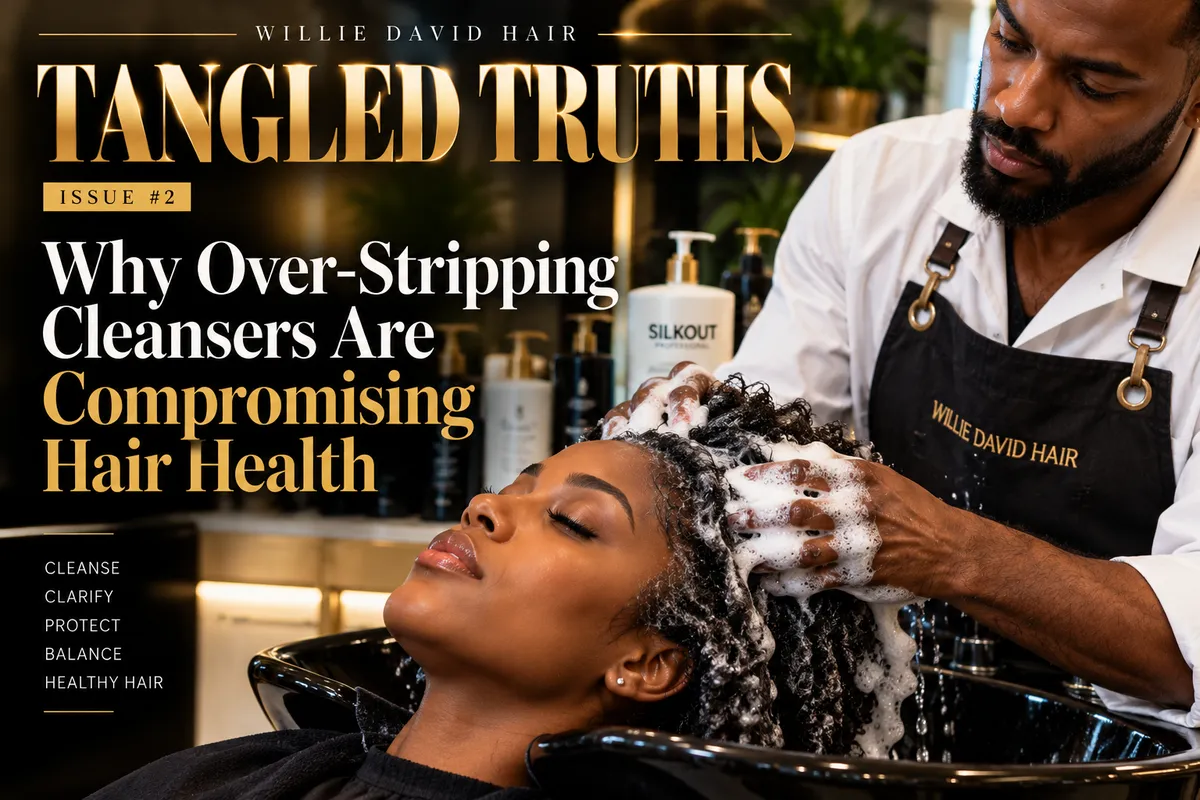
Why Over-Stripping Cleansers Are Compromising Hair Health
Baby, somewhere along the way we decided that if your hair doesn't feel like a freshly washed dinner plate, it isn't clean.
You know that feeling.
You shampoo.
You rinse.
You run your fingers through your hair and hear:
SQUEAK.
And somebody says:
“Now THAT'S clean.”
Maybe.
Or maybe your hair is trying to file a complaint.
Because cleansing absolutely matters. Product buildup, oils, sweat and residue can interfere with how the hair looks, feels and responds to styling.
But here's the Tangled Truth:
Clean hair and stripped hair are not the same thing.
The goal isn't to see how much we can remove.
The goal is to remove what doesn't belong there while respecting the hair that's left behind.
And baby, that's a very different assignment.
Clarifying Has a Job
Let's start by defending clarifying shampoo because somehow everything in hair care eventually gets accused of being evil.
Clarifying isn't bad.
Heat isn't automatically bad.
Protein isn't automatically bad.
Shampoo isn't bad.
Usually the problem is how we're using these things.
Clarifying cleansers are designed to provide a deeper cleanse when regular cleansing isn't enough.
They can be useful when we're dealing with things like:
Heavy product buildup
Excess oils
Residue from styling products
Certain mineral deposits
Buildup associated with swimming or environmental exposure
That can be especially important before certain salon services because I need to know what I'm actually working with.
If your hair is underneath seven layers of creams, oils, gels and whatever your cousin told you to buy last Thursday, I need to get through the guest list before I can meet the hair.
But clarification should have a purpose.
We're resetting the hair.
We're not trying to erase it from existence.
Hey Baby... Your Hair Doesn't Have to Squeak
This one is going to upset somebody.
That squeaky-clean feeling isn't my definition of success.
I don't need your hair making sound effects at the shampoo bowl to prove I did my job.
Clean is the goal. Stripped is not.
Some stronger cleansers can remove more oil and residue than gentler cleansers. Depending on the formula, how often they're used and the needs of the individual hair and scalp, that can leave hair feeling dry, rough or more difficult to manage.
That's why I don't believe every head needs the same shampoo every appointment.
Sometimes we need a deeper cleanse.
Sometimes we don't.
The cleanser has to match the assignment.
Baby, we're shampooing hair.
We're not pressure-washing the driveway.
What Does “Over-Stripped” Actually Mean?
Let's keep this simple.
Your hair naturally contains and interacts with oils, water and conditioning substances that affect how it feels and behaves.
Cleansing removes dirt, oil and product residue.
That's its job.
But when cleansing is unnecessarily aggressive or repeated more often than the hair and scalp require, some people may notice that the hair becomes:
Drier
Rougher
More tangled
Harder to detangle
More prone to friction
Less manageable
That doesn't mean every strong cleanser damages every head of hair.
And it doesn't mean clarifying shampoo should be thrown in the trash.
It means frequency, formulation, technique and the condition of the hair matter.
Sound familiar?
Hair care keeps coming back to balance because apparently the hair refuses to participate in internet extremes.
The Cuticle Matters
Here's our little science moment.
The outermost layer of the hair shaft is called the cuticle.
Think of it as overlapping protective scales surrounding the inner portions of the strand.
The condition of that surface affects things like:
Smoothness
Shine
Friction
Tangling
How the hair feels
Cleansers can differ in formulation, surfactants and pH, and those differences can affect how hair feels after washing.
But I want to correct one common oversimplification:
We shouldn't think of the cuticle as a little door that shampoo simply opens and conditioner magically closes.
Hair is more complicated than that.
What matters for us in the salon is the practical result:
After cleansing, what condition did we leave the hair in for the next step?
Because shampoo isn't the entire service.
It's preparation for everything that follows.
Stronger Doesn't Automatically Mean Better
There's a temptation in hair care to believe that if something works, doing it harder must work better.
Baby, that's how we end up in trouble.
If shampoo cleanses...
STRONGER SHAMPOO MUST CLEANSE BETTER.
If heat straightens...
MORE HEAT MUST STRAIGHTEN BETTER.
If conditioner helps...
HALF THE BOTTLE MUST HELP MORE.
No.
Professional hair care is not about maximum force.
It's about appropriate force.
A deeper cleanser may be exactly what your hair needs when there's significant buildup.
That same cleanser may be unnecessary every single time you shampoo.
The question isn't:
“Is this shampoo strong?”
The question is:
“Is this the appropriate cleanser for what we're trying to accomplish today?”
Now we're thinking like professionals.
Textured Hair Deserves Thoughtful Cleansing
Textured hair can be particularly prone to dryness because natural oils from the scalp may not travel along bends and curls as easily as they do along straighter hair.
Add styling products, manipulation, heat, color or chemical services, and cleansing decisions become even more important.
That doesn't mean textured hair is fragile by definition.
And it doesn't mean textured hair shouldn't be thoroughly cleansed.
It means we should stop treating every head of textured hair as though it has exactly the same needs.
Some clients use heavy styling products.
Some barely use anything.
Some exercise frequently.
Some wear protective styles.
Some have color.
Some have chemically treated hair.
Some have scalp concerns that may require guidance from a dermatologist rather than another bottle from the beauty supply store.
The hair and scalp in front of me determine the conversation.
Not somebody else's routine.
Buildup Isn't Healthy Hair Either
Now don't take this article and run to the opposite extreme.
Because somebody is already thinking:
“See! Willie said clarifying shampoo is bad.”
No, Willie did not.
Buildup can create its own problems.
Heavy layers of styling products, oils and residue can leave hair:
Dull
Heavy
Coated
Difficult to style
Harder to properly condition
So avoiding effective cleansing because you're afraid of “stripping” the hair isn't the answer either.
We need the hair clean enough for the products and techniques that follow to do their jobs.
That's why this isn't a battle between:
CLARIFY
and
NEVER CLARIFY.
The answer is:
Clarify when the hair needs clarification.
Revolutionary, I know.
The Shampoo Bowl Sets Up the Entire Service
This is one of the things I want clients to understand about Willie David Hair.
The shampoo bowl isn't the little thing we rush through before we get to the “real” service.
It is part of the real service.
If I'm preparing you for a silk press, your cleansing and conditioning matter.
If I'm preparing you for a treatment, cleansing matters.
If we're dealing with buildup, cleansing matters.
If we're trying to understand why your hair suddenly isn't behaving the way it normally does...
Guess where I'm looking?
At the whole routine.
And that starts at the bowl.
Cleansing and Conditioning Work Together
Cleansing isn't supposed to exist in isolation.
After we've appropriately cleansed the hair, conditioning helps improve things like softness, manageability and detangling.
What type of conditioning the hair needs can vary.
Sometimes we're focused on moisture.
Sometimes strengthening support may be appropriate.
Sometimes the biggest problem was simply removing buildup so the hair could respond better to the rest of the service.
That's why I don't want to automatically reach for the strongest shampoo followed by the heaviest conditioner and call that “balance.”
Good hair care is intentional.
Every product should have a reason for being there.
Stop Treating Dryness With More Everything
Here's another cycle I see.
Hair feels dry.
So we add more conditioner.
Still dry.
Add oil.
Still feels wrong.
Add another mask.
Then another leave-in.
Now the hair is coated, still doesn't feel right, and we're shopping again.
Baby...
Sometimes we need to go back to the beginning.
How are you cleansing?
How often?
What are you putting on the hair between shampoos?
Are you removing that buildup effectively?
Are you using products appropriate for your hair?
How are you styling?
What's happening with heat?
When was your last trim?
Dry-feeling hair doesn't have one universal cause.
That's why throwing more product at it without understanding the routine can create another problem instead of solving the first one.
The Willie David Hair Approach
At Willie David Hair, cleansing is the first act of preparation.
I'm not trying to strip your hair down just so I can brag about how clean it is.
I'm preparing it for what comes next.
That means I'm considering:
The condition of the hair.
The scalp.
Product buildup.
Previous services.
The service we're performing today.
And what I need the hair to do afterward.
Sometimes that calls for deeper cleansing.
Sometimes it doesn't.
But the decision should have a reason behind it.
Because if we're trying to Make Hair Healthy Again, we can't start the service by ignoring what the hair is telling us.
Your Home Routine Matters Too
Professional care doesn't stop when you leave the salon.
What you do at home affects what I see when you come back.
If you're constantly layering products without thoroughly cleansing them away, eventually we're going to have to deal with that buildup.
If you're using an aggressive cleanser constantly because you think “squeaky” means healthy, we may need to rethink that too.
Your shampoo should fit into a routine.
Not a punishment.
Not a detox challenge.
Not whatever social media decided everybody needed this month.
A routine.
When Should You Clarify?
There isn't one schedule that works for everybody.
Whether you need a deeper cleanse can depend on factors such as:
How much product you use
The types of products you use
Your scalp and hair needs
Swimming
Water quality
Your styling routine
How frequently you shampoo
The services you're preparing for
That's why I don't want to tell every person:
“Clarify every X number of days.”
Your hair doesn't own a calendar.
Pay attention to how it behaves.
And when you're unsure, that's exactly where professional guidance becomes useful.
The Tangled Truth
Clarifying shampoo isn't the enemy.
Overdoing anything can become the problem.
The goal of cleansing isn't to leave your hair begging for mercy.
It's to remove what needs to go so we can properly care for what needs to stay.
Cleanse with purpose.
Condition with intention.
Pay attention to the hair in front of you.
And baby...
If your hair is squeaking loud enough for the people in the waiting room to hear it, we might have gone too far.
Clean hair?
Absolutely.
Stripped hair?
We're not doing that.
That's how we Make Hair Healthy Again.
Carry on.