Blog Post
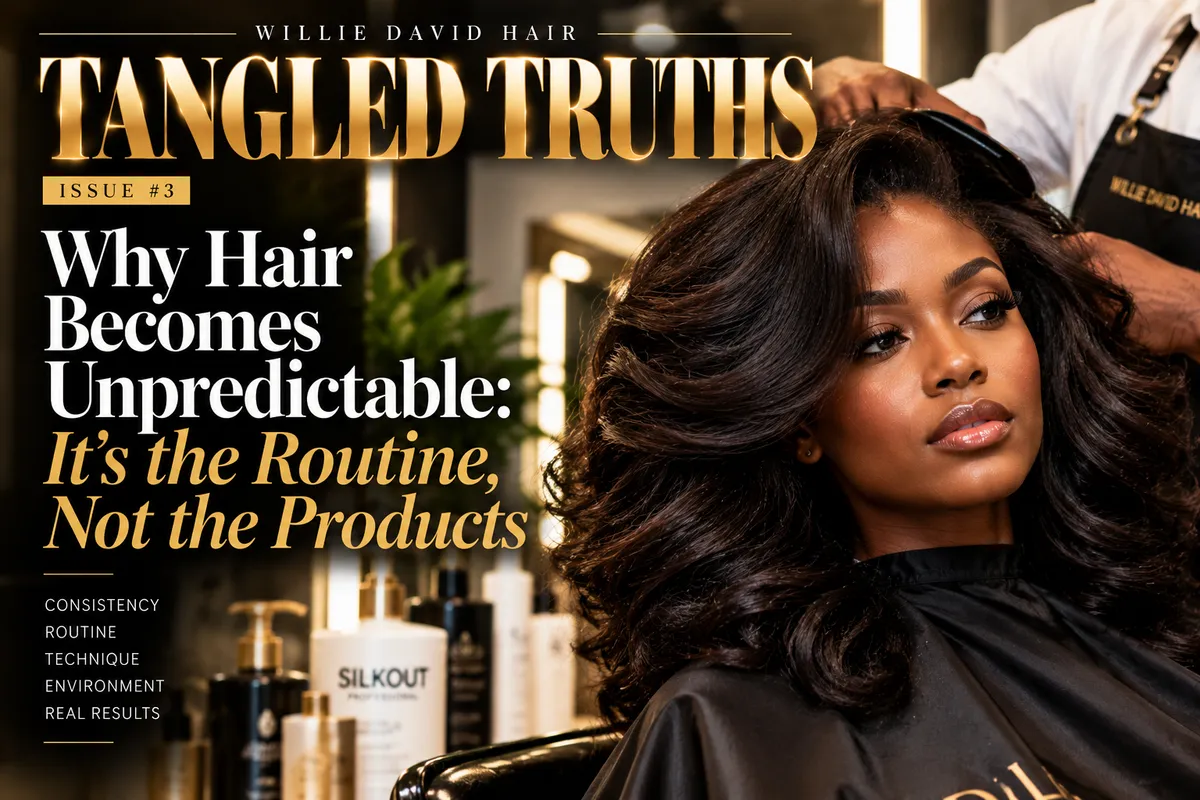
Why Hair Becomes Unpredictable: It’s the Routine, Not the Products
Baby, when your hair starts acting crazy, somehow the products always end up in court.
The shampoo did it.
The conditioner stopped working.
The treatment isn't treating anymore.
That oil everybody on TikTok swore would change your life has now been demoted to the back of the cabinet.
So what do we do?
Buy something else.
Then something else.
Then something else.
And before you know it, your bathroom looks like the beauty supply store has a satellite location.
But here's the Tangled Truth:
Sometimes the products aren't the problem. Your routine is.
Hair responds to what we repeatedly do to it. How often we cleanse it. How we condition it. What we put on top of what. How we style it. How much heat we use. How we protect it at night. And whether we're consistent long enough to actually understand what's working.
Before you fire another product, baby, let's investigate the routine.
Your Hair Isn't “Acting Funny”
One of my favorite things clients say is:
“Willie, my hair has just been acting funny.”
Baby, your hair doesn't have a sense of humor.
Something changed.
Maybe you changed products.
Maybe you've been working out more.
Maybe you've been using more heat.
Maybe it's been longer between shampoos.
Maybe you added color.
Maybe Miami decided the humidity needed to personally attack you.
Maybe you've been layering six products together because somebody online called it a “routine.”
The point is, hair doesn't suddenly wake up and decide:
“Today I'm going to embarrass her.”
Changes in how your hair looks and feels can have many causes. The job isn't to immediately blame the last bottle you bought.
The job is to start asking questions.
Products Are Only Part of the Story
A good product can be useful.
A professional product can be useful.
An expensive product can be useful.
But none of those words mean automatic results.
Products are tools.
And just like any other tool, how you use them matters.
You can have an excellent shampoo and still have problems if you're not cleansing thoroughly enough for your hair and scalp needs.
You can have a wonderful conditioner and still struggle if you're piling it over buildup.
You can own an entire shelf of treatments and still not know which one your hair actually needs.
That's why I'm much more interested in your routine than the number of products sitting in your shower.
Hey Baby... Put the Credit Card Down
This needs to be said with love.
Your hair did one thing you didn't like on Tuesday and by Wednesday you've ordered four new products.
Stop it.
Baby, Amazon is not your trichologist.
And TikTok does not know what's happening on your head.
If we change shampoo this week, conditioner next week, add a treatment the following week, start a new oil three days later and then switch everything again...
How are we supposed to know what actually worked?
Or what caused the problem?
Sometimes the best thing you can do for your hair routine is stop adding things long enough to pay attention.
Consistency Gives You Information
This is one of the reasons I believe in structured hair care.
Consistency doesn't mean doing exactly the same thing forever.
Hair needs can change.
Seasons change.
Styles change.
Chemical services change things.
Color can change things.
Age can change things.
Your lifestyle can change things.
But when your basic routine has some consistency, we establish a baseline.
Then when something changes, we have a better chance of identifying what changed with it.
That's useful information.
If everything changes at once, we're guessing.
And baby, I have been doing hair too long to be playing Guess Who with somebody's edges.
Cleansing Matters More Than People Think
Let's start at the beginning.
You cannot build a good hair-care routine without talking about cleansing.
How often someone should shampoo isn't one universal number. It can depend on the scalp, hairstyle, activity level, product use and individual hair needs.
But two things can create problems:
Not cleansing effectively enough for your needs.
and
Using cleansing methods that are unnecessarily harsh for your hair and scalp.
Product buildup can interfere with how the hair feels and how subsequent products perform.
At the same time, repeatedly using harsh cleansing practices can leave some hair feeling dry or difficult to manage.
The goal isn't:
Shampoo constantly.
And it isn't:
Avoid shampoo because somebody told you shampoo is evil.
The goal is appropriate cleansing for your hair, scalp, lifestyle and styling routine.
See how boring common sense is?
That's why it never goes viral.
More Moisture Isn't Always the Answer
Your hair feels dry.
So you add moisture.
Still feels off?
More moisture.
Another mask.
Another leave-in.
Another cream.
Another oil.
Baby, at some point we're making gumbo.
Moisture and conditioning are important, especially for textured hair, but piling on products doesn't automatically solve dryness.
Sometimes the issue may involve buildup.
Sometimes the hair needs a trim.
Sometimes your styling practices need attention.
Sometimes chemical or heat damage has changed how the hair behaves.
Sometimes you may need a different balance of conditioning and strengthening care.
The answer depends on what's actually happening.
Treat the hair you have, not the symptom you're afraid of.
Protein Isn't the Villain Either
Protein has somehow joined heat and shampoo on the internet's Most Wanted list.
Protein-containing products can be useful in some routines, particularly when the hair would benefit from strengthening support.
But that doesn't mean everybody needs a protein treatment every Tuesday at 7:14 p.m.
And it doesn't mean protein is automatically responsible anytime hair feels stiff or dry.
Hair care isn't supposed to be a war between:
TEAM MOISTURE
and
TEAM PROTEIN.
The goal is appropriate care based on what the hair needs.
That's why professional assessment can be helpful.
Sometimes what you think you're experiencing and what I see when I actually get my hands in the hair are two different conversations.
Stop Layering Everything You Own
Another routine problem?
Product layering.
Leave-in.
Cream.
Oil.
Serum.
Mousse.
Heat protectant.
Another serum because apparently the first serum got lonely.
Products can absolutely work together, but that doesn't mean every product in your bathroom belongs on your hair at the same time.
Too much product can leave hair coated, heavy or difficult to style.
It can also make it harder to understand which product is actually contributing something useful.
I want products to have a job.
If I can't explain why we're using it, we need to ask whether it belongs in the routine.
Because healthy hair care isn't about collecting products.
It's about making intentional decisions.
Your Styling Habits Are Part of Your Routine Too
Your routine isn't just what happens in the shower.
How are you detangling?
How often are you using heat?
Are you using heat protection when appropriate?
Are you repeatedly manipulating the same areas?
How are you protecting your hair while sleeping?
Are you maintaining your ends?
Are you wearing a “protective style” so long that it has developed seniority?
All of that matters.
You can't mistreat the hair six days a week and expect conditioner on Sunday to come in like Olivia Pope and fix everything.
Products support your routine. They cannot replace one.
Environment Matters
And since we're in Miami, let's stop pretending the weather doesn't get a vote.
Humidity can affect how hair behaves.
Sweat can affect your style.
Sun exposure, swimming, exercise and your daily environment can all influence what your hair needs.
So if something that worked beautifully in January suddenly feels different in July, that doesn't necessarily mean the product “stopped working.”
The conditions changed.
Your routine may need to adjust with them.
That's another reason I don't believe in rigid hair commandments.
Consistency doesn't mean refusing to adapt.
It means having enough structure to know when you need to adapt.
Good Products Can't Rescue Bad Habits
This one might hurt somebody's feelings.
You can buy professional products.
You can buy luxury products.
You can buy the entire SilkOut Professionals collection.
But if the routine surrounding those products doesn't make sense, the bottle cannot perform miracles.
A product cannot compensate for every styling habit.
It cannot trim your ends.
It cannot control how hot you set your tools.
It cannot stop you from sleeping without protecting your hair.
It cannot climb out of the bottle at 11:30 p.m. and tell you:
“Baby, don't do that.”
That's what I'm here for.
Products are part of healthy hair care.
They are not the entire strategy.
The Willie David Hair Approach
At Willie David Hair, I don't want you leaving the salon with beautiful hair and absolutely no idea what to do with it tomorrow.
That's not enough.
The goal is to help you understand what your hair needs, what we're using, why we're using it and what you should be doing between appointments.
That doesn't mean your home routine needs seventeen steps.
Actually, I usually prefer the opposite.
Cleanse appropriately.
Condition intentionally.
Treat when needed.
Style responsibly.
Protect the hair.
Pay attention.
Simple doesn't mean careless.
Simple means we know what each step is supposed to accomplish.
A Routine Should Give You Clues
One of the benefits of consistency is that you begin learning your own hair.
You notice:
“My hair feels different when I go too long between shampoos.”
“My ends aren't behaving the way they normally do.”
“I've been using more heat lately.”
“This started after I changed my color.”
“My hair behaves differently when I'm exercising more.”
Now we're learning.
That's what I want.
Because the goal isn't for you to become afraid of your hair.
The goal is for you to understand it.
When Something Stops Working, Don't Panic
If your routine was working and suddenly your hair feels different, don't immediately throw everything away.
Start with questions.
What changed?
Did you introduce something new?
Did you remove something?
Has your styling changed?
Has your environment changed?
Has it been longer than usual between trims or appointments?
Have you recently had color or another chemical service?
Are you using more heat?
Are you cleansing differently?
Sometimes the answer is a product change.
Sometimes it isn't.
We diagnose the routine before we sentence the bottle.
Healthy Hair Doesn't Require a Complicated Life
This may be the biggest Tangled Truth in this entire conversation.
You do not need a bathroom full of products to care about your hair.
You need a routine that makes sense for:
your hair,
your lifestyle,
your styling habits,
and your goals.
Then we adjust when the hair tells us something has changed.
That's a system.
Not because we're trying to make hair care sound technical.
Because structure keeps us from making random decisions every time the hair has a bad Tuesday.
The Tangled Truth
When your hair becomes unpredictable, don't automatically blame the products.
Look at the whole routine.
What are you doing consistently?
What changed?
What are you layering?
How often are you cleansing?
How are you styling?
How are you protecting the hair between appointments?
Sometimes you don't need another product.
You need a better plan.
Products are tools.
Your routine is how you use them.
And when education replaces guesswork, taking care of your hair gets a whole lot simpler.
That's how we Make Hair Healthy Again.
Carry on.